Viscosity is a critical but easy-to-overlook quality parameter across UAE industry — from petrochemical processing in Ruwais and Jebel Ali to paints, adhesives, and coatings manufacturing, food and beverage production, and pharmaceutical formulation. A&D Japan is the only manufacturer of sine-wave vibro (tuning-fork) viscometers, and A&D Gulf supplies the full range — stand-type SV-A benchtop units, handheld SV-H portables, and the RV-10000A tuning-fork rheometer — from our JAFZA base, with technical guidance on matching the right instrument to your fluid and application.
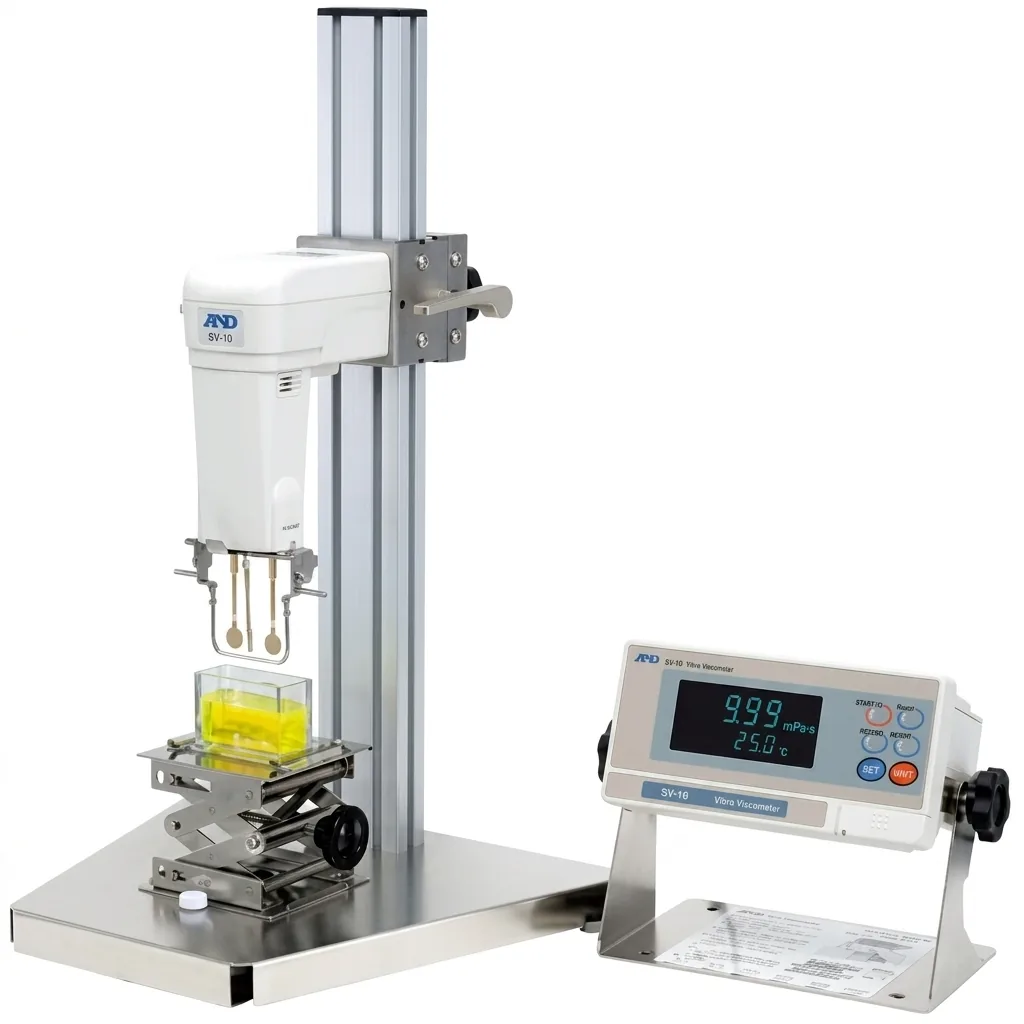
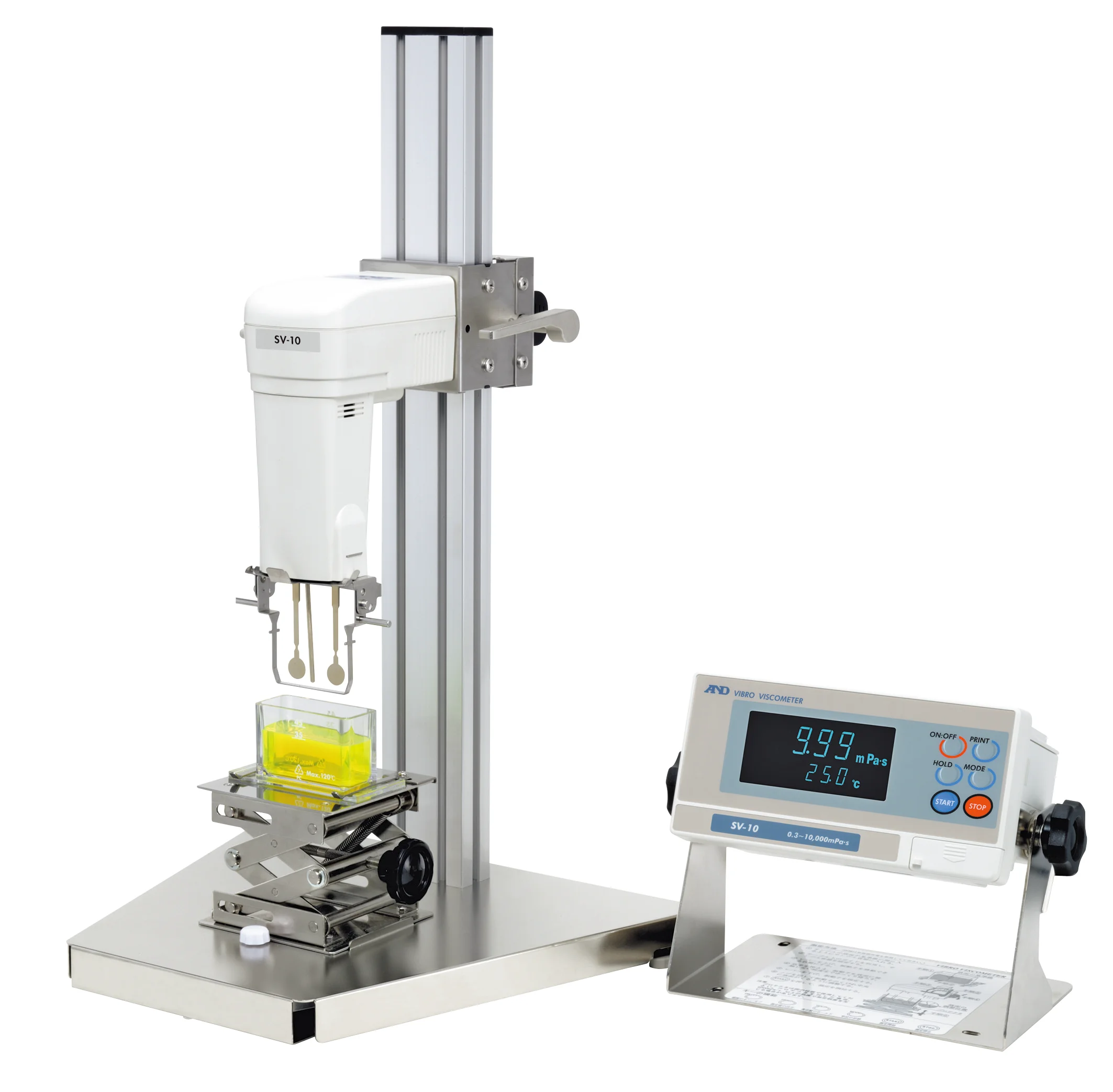
A&D's SV series tuning-fork vibro-viscometer is the workhorse of the range: it has no spindle, no rotor, and no moving parts rotating in the sample, measuring viscosity continuously across 0.3 to 100,000 mPa·s (model dependent) using a sine-wave vibration method at 30 Hz, with repeatability of 1% of the measured value across the full range — no sensor or spindle changes. Readings arrive in about 15 seconds, and the sensor plates simply wipe clean between samples — a real advantage in production environments processing multiple fluid batches per shift, such as paint, ink, and food-sauce manufacturing. The current SV-A generation (SV-1A, SV-10A, SV-100A) adds titanium sensor plates and, on the SV-1A, measurement from as little as 2 ml of sample — enough for blood, cosmetics, and other precious fluids.
Field and at-line testing is its own use case: the handheld SV-H series (SV-1H, SV-10H, SV-100H) puts the same tuning-fork measurement in a portable, carrying-case format for technicians who need a quick viscosity check on a production line, tanker delivery, or remote site rather than a controlled lab bench — relevant for fuel, lubricant, and bulk-chemical QC across UAE logistics and distribution hubs. For shear-rate-dependent and non-Newtonian fluid characterisation — common in polymer, cosmetics, and specialty chemical work — the RV-10000A rheometer varies its sensor-plate amplitude to sweep shear rates, with real-time graphing on a touch controller.
UAE ambient temperatures present a real measurement challenge: viscosity is highly temperature-sensitive, and a fluid tested at 25°C in an air-conditioned lab can read very differently from the same fluid at 40°C+ ambient on a production floor or loading bay. Every SV/RV instrument measures temperature simultaneously with viscosity (built-in 0–160°C sensor beside the plates), and the optional water jacket enables controlled viscosity-temperature profiling so QC results stay meaningful across the conditions your product actually experiences.