
Food Safety & Quality Control Instruments for F&B Production
Checkweighing · X-ray inspection · Metal detection · Moisture content testing · HACCP compliant
Food manufacturers in the UAE and GCC operate under UAE and Gulf technical regulations administered by the Ministry of Industry and Advanced Technology (MOIAT, which absorbed ESMA in 2020), HACCP-based food safety plans, and the GFSI-benchmarked certification schemes their customers ask for — BRCGS, FSSC 22000 and IFS Food all carry foreign-body detection and weight-control clauses. A&D Gulf supplies A&D Japan's complete quality-gate portfolio — checkweighers, X-ray inspection systems, metal detectors, and moisture analyzers — from a single authorised source in JAFZA, with installation, integration, and calibration support across the GCC.
Key Requirements in This Sector
- End-of-line checkweighing to OIML R 51 (GSO OIML R 51-1:2021), with the right instrument class where the weight is used in trade
- X-ray inspection able to run as a HACCP critical control point — defined detection limits, certified test pieces, reject confirmation and logged records
- Metal detection sensitivity to Fe 1.0 mm, SUS 1.5 mm in typical food products
- Moisture content measurement for shelf-life and labelling compliance
- Integration with existing production line PLC and SCADA systems
- Washdown-rated equipment for wet processing environments
Not sure which instrument fits your food & beverage work? Tell us what you weigh and we will point you at the right one.
Inline checkweighing is the first line of defence against short-weight claims and giveaway losses. The A&D AD-4961 ProteX checkweigher delivers dynamic weighing accuracy with reject rates low enough to satisfy modern retailer specifications. The system integrates with A&D's metal detection units via simple digital I/O, enabling combination checkweigh-and-detect lines without complex PLC programming.
X-ray inspection identifies contaminants that metal detection cannot: glass, ceramic, dense plastic, stone, and bone fragments in packaged food. The A&D AD-4991 ProteX X-ray inspection system uses high-contrast imaging algorithms developed specifically for food applications, delivering reliable detection in products with variable density — raw meat, baked goods, and frozen foods where metal detectors frequently produce false rejects. Certification schemes such as FSSC 22000 certify your management system rather than the machine, so what an auditor looks for is the evidence around it: documented detection limits, certified test pieces run at a defined frequency, proof the reject diverted, and records that were reviewed. The AD-4991 is built to produce that evidence, and we supply the matching test pieces and calibration records.
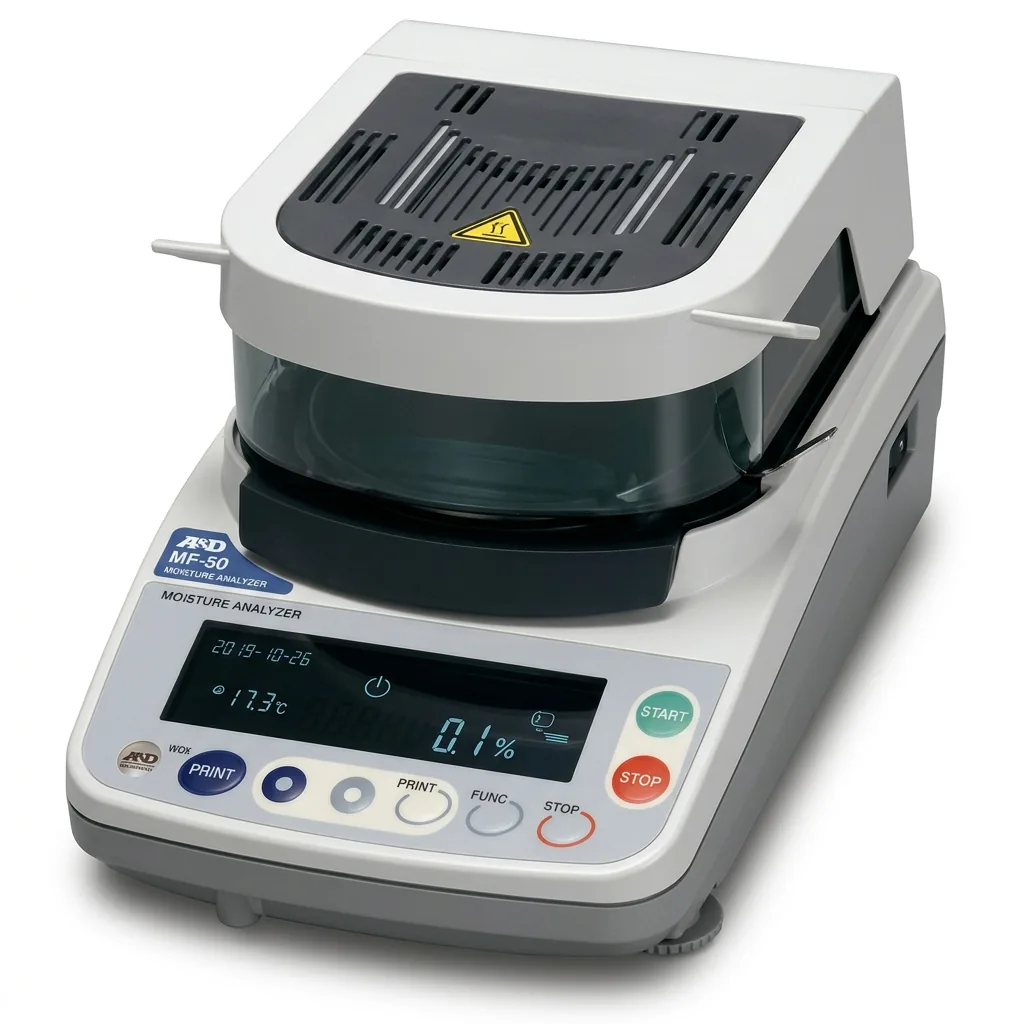
Moisture content is a key quality and shelf-life parameter for snack foods, dried fruits, spices, and baked goods. The A&D MS-70 and MF-50 moisture analyzers provide rapid loss-on-drying measurement using uniform halogen heating, delivering results in 3–8 minutes compared to 24–hour oven drying methods. The 0.001% to 0.1% moisture resolution range covers the full spectrum from QC sampling in the lab to production-line release testing.
Send us the model, the smallest quantity you need to weigh, and how many units — we will come back with a quotation.
Frequently Asked Questions
What inspection systems are required for food manufacturing in the UAE?
When should food manufacturers choose X-ray over metal detection?
How quickly can moisture analyzers return results compared to oven drying?
What our customers say
“Great customer service! Mr. Abrar helped and guided us to buy the products that suited our needs … even sent us tutorial videos on how to calibrate and use our products. One of our main concerns were if this was legitimate and genuine AND Japan. They showed us proof of authenticity signed and stamped by AND Japan … Highly recommended.”
Authorised A&D Japan distributor since 1986 — proof of authenticity supplied with every order.
Read our reviews on Google →Build a complete quality-gate line for your F&B facility
A&D Gulf can specify, supply, install, and calibrate your full inspection system from a single JAFZA base.
A&D Gulf FZE · Jebel Ali Free Zone (JAFZA), Dubai · +971 4 881 9900